The Execution Gap: Why Good Strategies Fail
This is the second article in AIA’s series on turning strategic intent into measurable impact. The first article, How Organisations Can Turn Strategic Intent into Measurable Impact, introduced AIA’s Strategy-to-Execution Value Chain – the four layers of strategy, portfolio management, project execution and monitoring and evaluation, held together by governance – and argued that the organisations that turn intent into impact are the ones that manage and govern the whole chain, not one layer of it. This article opens that chain at its second layer, portfolio management, and specifically at its first discipline: strategic alignment.
Every organisation has a strategy, though few successfully execute on it. Among the factors that determine whether this gap closes, one deserves particular attention: strategic alignment – the discipline of ensuring that every initiative your organisation undertakes can be directly traced to a specific strategic outcome. Directly traceable, with a measurable indicator and defined ownership.
However, the gap between strategic intent and on-the-ground delivery is not a new problem, but it remains one of the costliest. Think of it like a ship navigating at full speed: engines running efficiently, crew performing flawlessly, but heading toward the wrong destination because the navigation chart was never properly set and therein lies the cost of poor strategic alignment.
At its core, strategic alignment is about linking strategy to execution. That takes two things: a strategy with clear, measurable outcomes – KPIs, KRAs, or whatever indicators your organisation uses – and a direct line of traceability between what each initiative will deliver and those outcomes, reinforced later by a benefits realisation model that closes the loop. Get both in place, and delivering the initiatives becomes synonymous with delivering the strategy.
The consequences of misalignment are predictable. Funding and resources flow toward initiatives that are disconnected from strategic outcomes. Projects are delivered on time and on budget, yet the organisation looks back and asks: what value was delivered in actuality? In practice, this shows up as misdirected capital, initiatives that cannot be traced to any client-facing outcome, and a monitoring and evaluation function that reports on progress rather than value. In the public sector, that means budgets spent without a matching improvement in service delivery; in the private sector, it means capital and headcount tied up in projects that never move the needle on strategic priorities.
This is the execution gap, and it begins the moment strategy and value delivery lose their connection to each other. Closing it is one of the more direct levers an organisation has, and strategic alignment does much of that work.
Why Strategic Alignment Is a Necessity
When alignment is absent, two problems surface. First, organisations do the wrong things: initiatives get delivered on time and on budget, but that counts for little if they were never linked to a strategic outcome in the first place – execution quality cannot compensate for a portfolio that is solving the wrong problem. Second, leadership loses the basis for effective resource allocation. Trade-offs and prioritisation calls depend on knowing what each initiative is contributing strategically to the organisation; without that line of sight, decisions about what to fund, pause, or stop default to organisational politics or budget cycles rather than strategic merit.
Strategic alignment is not a document-signing exercise. It is a governance discipline that must be embedded in how initiatives are proposed, approved, resourced, and reviewed. The good news: it starts with your strategy itself. Before you can align a portfolio of initiatives to it, your strategy has to be capable of being aligned to in the first place – which is what the next section tests.
The Litmus Test: Where does your organisation fit on the maturity curve?
Before you can align initiatives to strategy, your strategy must have the ability to be aligned to. This is where most organisations underestimate the work. Figure 1 sets out a simple maturity curve for getting there: use it to answer two questions – where am I today, and what do I need to do to move up?
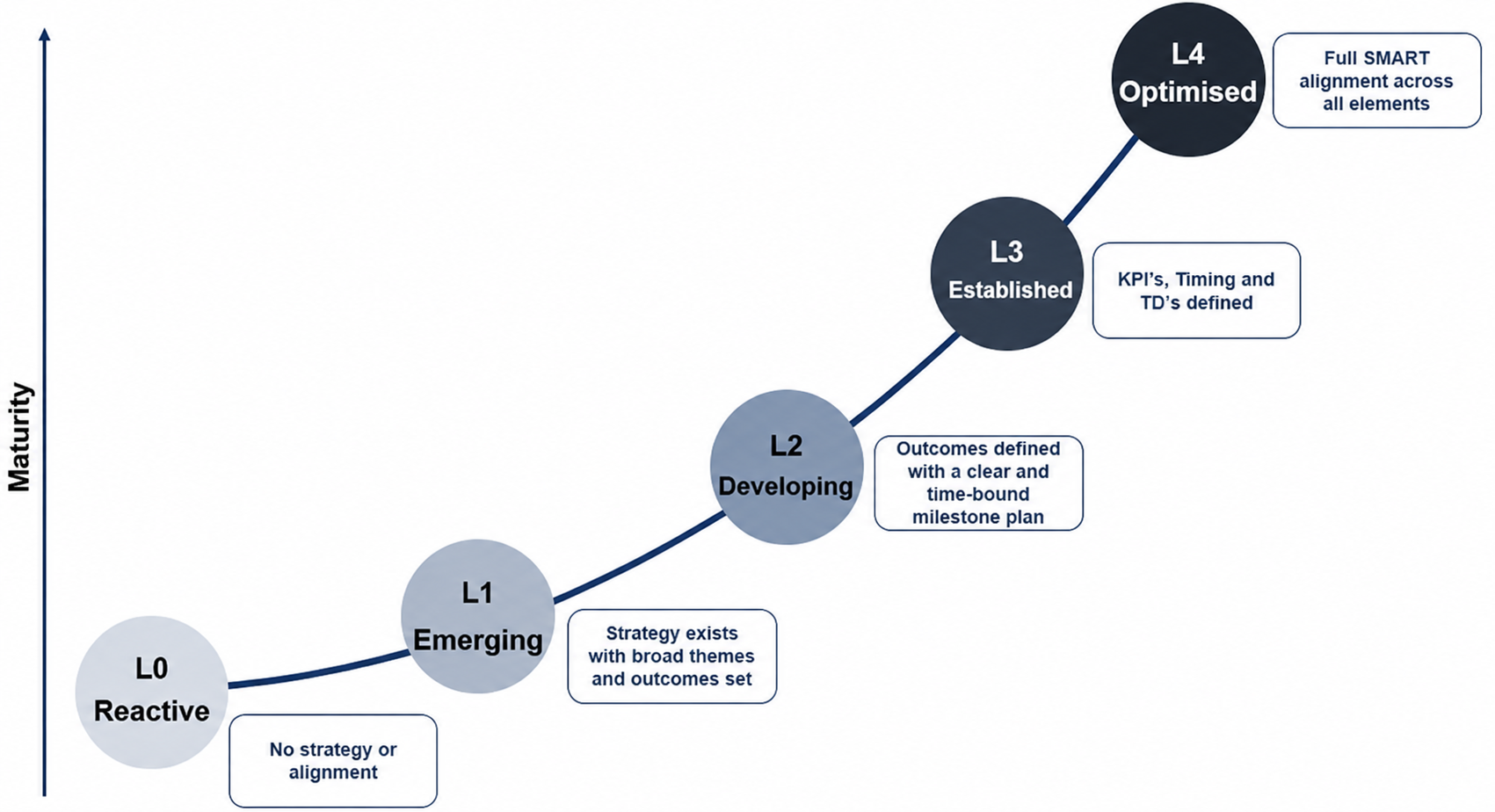
Most organisations overestimate where they sit. A strategy document with broad themes and objectives feels like progress, but if it carries no measurable indicators and no timing, it is still Level 1: a strategy exists, but nothing in it is yet capable of being aligned to. Reaching Level 2 means attaching a clear, time-bound milestone plan to each outcome. Level 3 means defining the KPIs and timing behind them – the minimum most organisations need before portfolio decisions can be trusted, and where both problems set out above start to close. Level 4 extends full SMART discipline (specific, measurable, achievable, relevant, time-bound) across every element of the strategy, at which point value delivery becomes systematic rather than accidental.
Making It Practical: From Strategy to Initiatives
Once your strategy sits at Level 2 or above on the curve, the next challenge is connecting it to the work your organisation does day to day and keeping that connection intact as priorities shift. Embedding strategic alignment is not a once-off exercise. It requires strong governance, consistent review, and the discipline to intentionally exclude initiatives that cannot be traced to a strategic outcome. Done consistently, this is what corrects the two problems set out earlier: initiatives get selected for the right reasons, and resourcing decisions get made on strategic merit rather than politics or habit.
In practice, the journey for robust strategic alignment begins with three practical steps: the first stops the wrong initiatives from entering the portfolio, the second protects resourcing trade-offs once they are in it, and the third embeds accountability for the value each one is meant to deliver.
|
| |||
1 Introduce a Strategic Demand Funnel |
| 2 Establish a Portfolio Review Candence |
| 3 Build a Benefits Register from Day One |
No initiative should enter the portfolio without a named strategic outcome. Build a simple intake process that requires traceability before approval |
| A quarterly portfolio review that assesses initiatives against strategic progress. This changes the conversation from “are we on schedule?” to “are we on track to deliver value? |
| Define expected benefits at the project approval stage, not at close-out. This ensures accountability is defined at initiation. |
These three steps are not a transformation programme but rather the minimum viable conditions for a portfolio to begin to deliver value rather than just activity. Hence, if your portfolio is busy, but your strategy is standing still, reach out to AIA. We help organisations turn strategic intent into tangible value.
19 August 2026 Digital Transformation African Competitiveness