A New Era for Southern Africa's Oil and Gas Industry
Southern Africa stands on the cusp of unprecedented development in its upstream oil & gas industry. Over the last 15 years, both Mozambique and Namibia have become two of the most promising oil and gas frontiers globally.
In June 2022, Mozambique entered the club of global LNG producers with the commissioning of the Coral South Floating LNG project in the Rovuma Basin in northern Mozambique. In October 2025, this was followed by the announcement that ENI had reached a Final Investment Decision (FID) on a second floating LNG liquefaction facility, Coral North.
In addition, two further large investments are being made to develop land-based liquefaction facilities in northern Mozambique, fed by gas from the same Rovuma basin. These projects represent some of the most important investments by both Total and ExxonMobil within their global oil & gas portfolios. Once these initial LNG trains are developed, probably by 2031, Mozambique will produce ~38 million tonnes per annum (MTA) of LNG, easily putting the country among the top 5 LNG exporters globally.
These projects are, however, merely the first phase of the development of the Rovuma basin. A number of additional LNG liquefaction trains are planned over the coming decades, depending on the prospects of global demand for gas and LNG.
In addition, Namibia has seen a boom in oil and gas discoveries over the last 4 years. In total, ~10-20 billion barrels of oil equivalent resources have been discovered. While a large part of this total resource may not be recoverable, these discoveries are likely to amount to 3-7 billion bbls of commercially recoverable oil & gas reserves. Depending on how these resources are developed, Namibia could find itself catapulted into the world’s top twenty oil producers within the next decade.
What is more, these are far from the only positive oil & gas developments or opportunities in the region. Tanzania, for instance, has discovered offshore gas resources in the range of ~47–50 Trillion Cubic Feet (TCF). While progress has arguably been slow in developing those resources, they remain a very substantial opportunity that will be exploited at some point.
In addition, South Africa itself has a substantial opportunity for oil and gas development. Two-thirds of the Orange Basin, the geological formation that has delivered the large discoveries in Namibia, sits within South African territorial waters. To date, there has been very limited exploration on the South African side of the border; however, the chance of major discoveries should such exploration take place is substantial.
The Economic Potential Beyond Oil and Gas Exports
It is therefore highly probable that these oil and gas developments in southern Africa will fundamentally reshape the region's economies over the next two decades. To give an idea of the size of the opportunity, the revenue from the initial LNG projects alone could generate ~US$20 billion per annum for Mozambique. This amount is roughly equivalent to the country’s entire current GDP. Namibia is quite likely to see an even larger potential revenue windfall relative to its economic size and population.
How South Africa Could Benefit from Regional Gas Development
The question for South African companies, large energy users, and policymakers is how the country positions itself to benefit from these developments.
It is not just the large investment and economic multiplier that will come with these projects but also, and arguably more importantly, about securing a large source of affordable energy supply for the region.
Firstly, the development of land-based LNG liquefaction facilities will see large volumes of gas brought ashore in northern Mozambique. While the development of these gas-fields is reliant upon the development of large-scale LNG facilities, a significant portion of gas production is earmarked for domestic usage in Mozambique. This gas can underpin the development of large-scale gas-to-power, fertiliser, and industrial heating.
Similarly, Namibia’s oil boom is likely to be accompanied by a large supply of associated gas. Once again, there is an opportunity to bring this gas ashore and develop a gas-based economy from competitively priced resources.
The development of these domestically available gas resources can provide an important source of energy for South Africa into the early-to-mid 2030’s. This is of particular importance for the country, considering the looming decommissioning of its coal-fired power generation capacity and the decline in current gas supply.
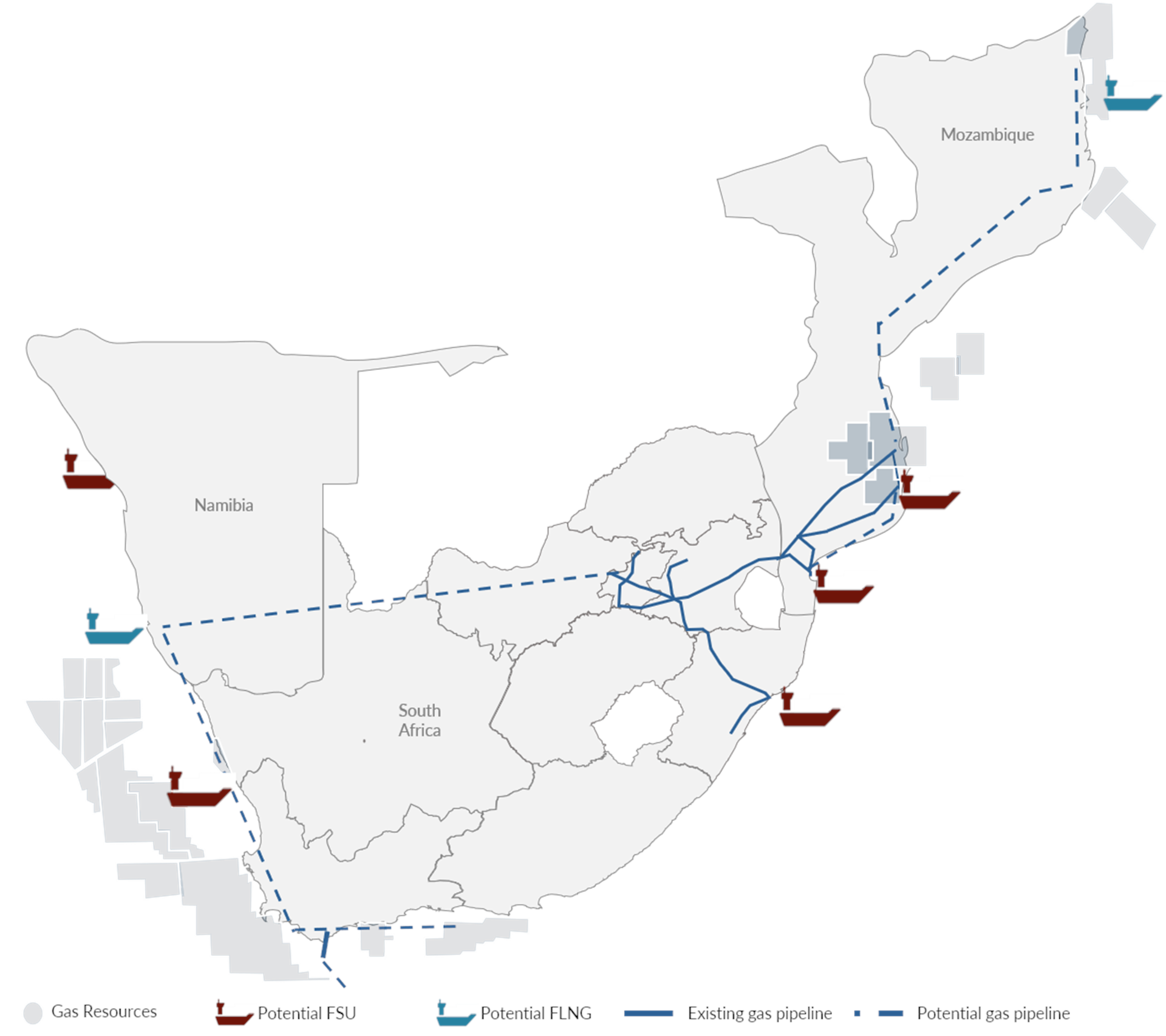
The map below provides a high level overview of the infrastructure and opportunity arising from each of these different areas.
The Infrastructure Investment Needed to Unlock the Opportunity
There are likely to be substantial opportunities for South African companies at virtually every point along these value chains, form the initial feasibility studies and construction, financing all the way through the opportunity to secure competitively priced energy and chemical feedstock.
Exploiting the opportunity will, however, require investment in the development of infrastructure and production capacity in four broad areas:
- The development of gas-to-power generation capacity in northern Mozambique and Namibia
- Investment in transmission lines and grid infrastructure
- Investment in gas transport, either in the form of physical pipelines or trucking and rail infrastructure, to bring gas to be used in various industrial processes
- Investment in fertilizer production, storage and distribution infrastructure in the region.
Now is the time for South African manufacturing, services industries and financial houses to embrace this opportunity.
15 October 2026 Oil & Gas Manufacturing Energy Transition